
“I think sometimes
you can put the chip
on your own shoulder.”
Mark Ferguson
Member of Parliament
Gateshead Central and Whickham
Mark Ferguson is the Member of Parliament for Gateshead Central and Whickham. He takes a special pride in representing part of the town where he grew up, and in helping shape its future. We spoke to him about aspiration, connection and how Gateshead is on the cusp of something special.
Interview by Arlen Pettitt
Photographs by Christopher Owens
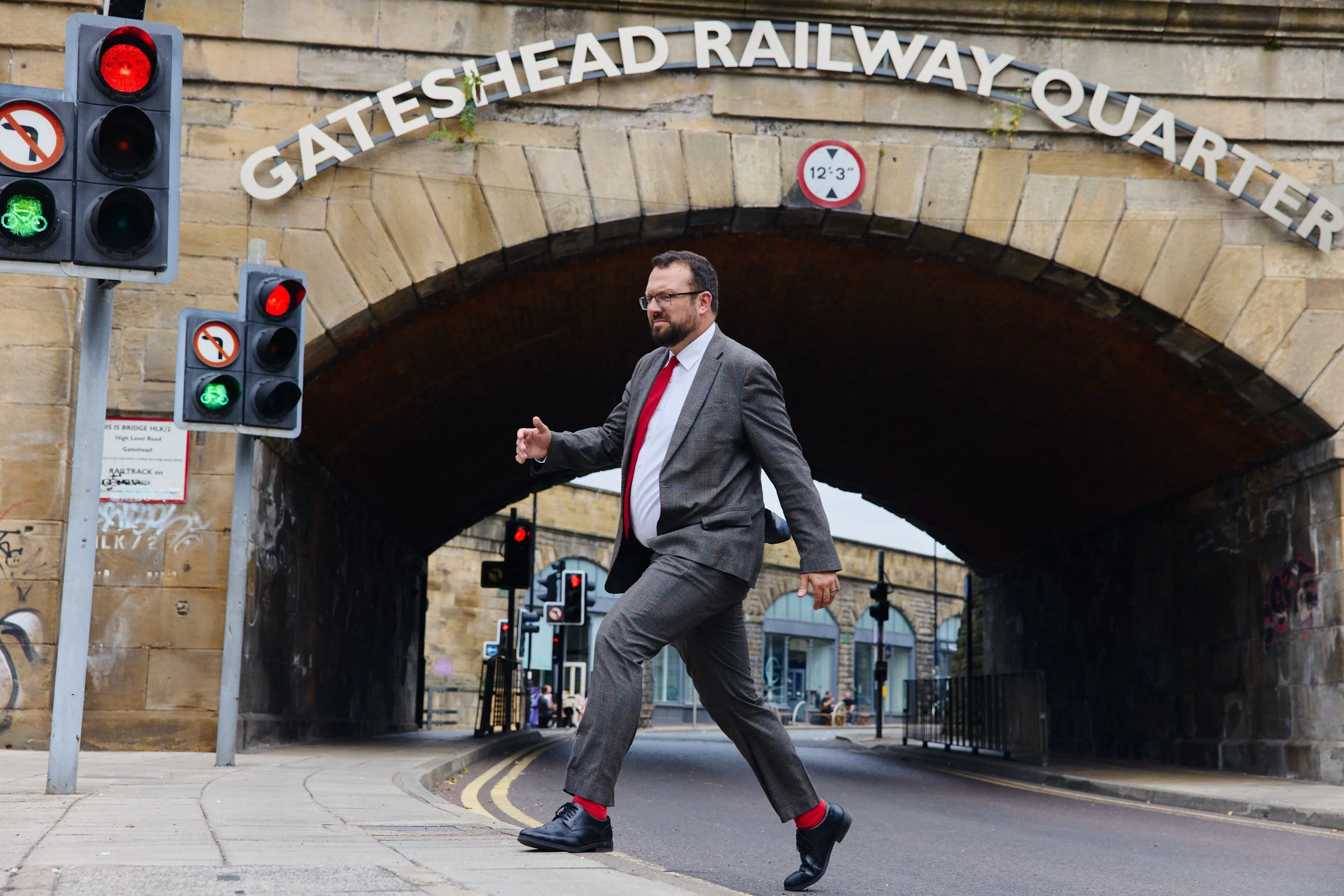
Gateshead’s Railway Quarter sits in a triangle created by the raised railway lines, running from the top of the High Level Bridge up to Askew Road.
Once upon a time, two of the three sides of the Railway Quarter were dominated by the dual-stations of Gateshead West and East, with the stationmaster’s office perched between the tracks where they diverge at the end of the bridge.
The Victorian stonebuilt arches on Wellington Street have always housed commercial units, and where they once benefited from the bustling station traffic, they’re now the heart of a regeneration scheme that’s aiming to tell a different story about Gateshead.
It’s in the Railway Quarter where we meet Mark Ferguson, the MP for Gateshead Central and Whickham since the 2024 General Election.
We’re not short of places to sit down for a chat, with Axis, Microbus, and the aptly named Station East, but we settle on The Central.

“She said ‘You've got as much right to be there as anybody else. Gateshead people can do whatever they want.’”
As we look for a quiet corner, Ferguson leads us through to a section in the back where he says he held his last birthday party.
Born the week after the Miners’ Strike ended, Ferguson grew up in the Borough of Gateshead, going to school in Crawcrook and Ryton.
He did well academically and was offered a place at Cambridge, but on results day was wondering whether he’d fit in when a teacher gave him a pep talk.
“She said ‘You've got as much right to be there as anybody else. Gateshead people can do whatever they want.’,” he remembers.
“I think sometimes you can put the chip on your own shoulder,” he says, explaining he found Cambridge to be more diverse than he was expecting - and that it will be even more so now.
It was at Cambridge where Ferguson met his wife. He was student union president and then went on to work for the Labour Party, as editor of the LabourList website, and at the trade union Unison.
“That was a dream job, to be honest”, Mark says of his time with Unison, where he was the National Political Officer, managing the relationship with Labour. “I got to represent teaching assistants, care workers, local government workers.”
He never expected to leave union roles, he says, but the opportunity to come home and run to represent Gateshead Central and Whickham was different, because the chance to represent people he grew up with, and “to become your mam and dad's MP, to become your little sister's MP. It was just an opportunity I couldn't miss.”
Growing up, Ferguson says his family weren’t “big P political”, and party politics wasn’t part of his life growing up - or even at university - but what there was was an awareness and engagement with politics as it impacted people’s lives, and regular discussion of what was in the news.
Entering secondary school in 1996, Ferguson sees himself as a product of New Labour’s investment in education, recalling new teachers, new buildings and new qualifications during his time at school.
One of the qualifications he was able to study was an A-level in government and politics, which set him on a course to where he is now.
Ferguson’s politics teacher - a man named Tony Dabb - also taught two of his team and worked with another, demonstrating the influence of a good teacher.
Although he enjoyed his time at university and speaks fondly of Cambridge, he doesn’t credit it with playing too big a role in his career choices.
What it did do is teach Ferguson about people.
“It made me realise that the people who you think have got all the answers have been given certain tools socially in how they handle situations”, he explains.
“Some people who look like they've got all the answers, you realise they've been trained to bullshit.”
There was a liberation in that realisation that no one has all the answers, and that encouraged an approach of using a solid work ethic and inquisitiveness to discover what he needed to know.
It’s a tactic that worked at university, and has echoes in his approach now.


“Some people who look like they've got all the answers, you realise they've been trained to bullshit.”
Walking around the Railway Quarter, Mark is waving and chatting to business owners and clearly revels in being approachable and knowing his patch.
“You gain a huge amount of knowledge about an area”, he says, “but it's literally an area that's been defined for you by the Electoral Commission.”
“People don't live in constituencies; MPs live in constituencies.”
It’s a mindset shift, to go from having a connection with the place you call home - in Ferguson’s case, Gateshead and the North East - to then having an extremely detailed relationship with a very specific place.
It creates some odd and frustrating situations, for MPs but more so for the people who live in the communities they serve.
“If you live on this side of the road, I am your MP and I can help you with your issue with the government department,” Ferguson explains, “or I can write to the council on your behalf, or I can help with the issues you might be having with your kid at school.”
“If you live on that side of the road, I regret to inform you that you must write to the office of such and such MP instead,” he continues. “Sometimes you've got to remember to be a normal person about it.”
The life of an MP is a strange one, where you are elected to represent a place and then - for nine months of the year - you spend most of your time away from it, in Westminster.
Ferguson says he is lucky that his wife - a teacher - is very supportive, and says when he made the decision to run for Parliament, they talked through what it would mean for them and their life.
Even going in with his eyes open, having worked with and knowing MPs, there was still a significant adjustment to make.
Part of learning the job is in Parliamentary procedure (“Has the right honorable member considered the points made by the member for such and such constituency?”), which unfortunately can make debates impenetrable for ordinary members of the public, and favours those who have developed those debating skills early - at school or university.
Ferguson talks through some of the strange rules of Parliament.
There’s ‘line of sight’ where you can’t walk between someone addressing the House and the Speaker or the Minister. This can make it difficult to get into or out of the room during a debate.
There’s how to address people, and who gets called ‘Right Honourable’ rather than just ‘Honourable’, which is dictated by membership of the Privy Council, in practice whether someone is a past or present member of the Cabinet.
Then there’s the accepted practices of giving a speech and contributing to a debate, something which Ferguson says is best learned just by observing.
“I really enjoy sometimes just being in the Chamber and hearing the speeches,” he says, “sometimes you think, I don't agree with any of this, but it's really useful for me to have the opposite point of view.”
“To become your mam and dad's MP, to become your little sister's MP. It was just an opportunity I couldn't miss.”

The other part of learning the job is knowing how to run a constituency office, and directly support the public by making a difference.
“There is financial support for setting up an office,” Ferguson explains, “but Parliament doesn't tell you what type of jobs you should have in your office. They don't tell you what type of office you should run. They don't tell you what your campaign priorities should be locally. Effectively, how you are as an MP locally is the blankest slate.”
His office, he says, is built around casework support, and responding quickly to correspondence, including writing actual letters.
Ferguson remembers being a teenager and writing to his local MP John McWilliam, who was MP for Blaydon for more than 25 years. He got a reply back, and kept it. It’s still filed away at his parents’ house all these years later.
“You can rip up the letter I send you back and chuck it in the bin if you want,” he jokes, “but you've physically had something in your hands from me!”
He talks about the importance of that connection, and taking time to speak to someone, especially when visiting schools and meeting young people.
Politics, party politics especially, involves compromise and that can get in the way of authentic connection.
“Whether it's speaking to people on the doors, whether it's writing somebody a letter, whether it's posting something on social media, I won't do anything I don't believe in,” Ferguson says.
“If I was ever sufficiently unhappy with something that my party was doing,” he says, “if I ever thought that something was bad for Gateshead, I have absolutely no problem in saying it.”
“I think where you can get yourself in knots is where you are defending things you don't believe. You are saying things you don't believe, but that's the same in any walk of life.”


“I really enjoy sometimes just being in the Chamber and hearing the speeches. Sometimes you think, I don't agree with any of this, but it's really useful for me to have the opposite point of view.”

It’s an interesting and challenging time for Gateshead, but also a time with the potential for a lot of positive change. Part of that is in forging a distinct identity within the context of North East devolution.
Ferguson says he’s “lived that identity crisis” having grown up in Gateshead, with Newcastle feeling like ‘his city’, but supporting Sunderland.
“There's a kind of unpopularity you get as an MP,” he says, “but try being 12 years old pretending to be Craig Russell in the school playground!”
He compares Gateshead’s position to Newcastle to Salford’s position to Manchester, where Salford presents itself as “a big confident town that's near a big confident city.”
“I think Gateshead's on the cusp of that now,” he says.
Ferguson speaks fluently on the town planning aspects of the centre of Gateshead, how the dangerous Gateshead flyover was part of a grand vision fifty years ago, but now acts as a barrier for modernisation, and the way in which communities which used to be central were dispersed by high rises.
It’s clear his aim is to support the local authority and developers to reverse that, bringing families, communities and jobs back into the centre of the town.
“The council are doing a lot of work on this regeneration piece,” Ferguson says, “and the meeting of the Labour government’s investment, private sector interest and the council having its plans. It’s all really coming together at the right time.”
“But they would admit that what's happened in the Railway Quarter hasn't come about because of any sort of council intervention,” he continues, “it has been incubated and supported by the council, but it's actually a lot of these businesses organically wanting to open here.”
There are plans for thousands of new homes in Gateshead, and thousands of new jobs - not least in construction, where Gateshead College is part of the skills pipeline.
“There's this huge capacity for people to come out of Gateshead schools and Gateshead College,” Ferguson explains, “and, if they want to, to have these opportunities to work in redeveloping their own town center, build up their homes for themselves and their families and gaining those skills that'll set them up for life.”
It’s a 10-, 20- or 30-year plan, rather than a 2- or 5-year one, but it’s backed by longer term planning in other parts of the region too, where the North East Combined Authority is encouraging areas to specialise and collaborate rather than work in internal competition.
“I understand the scepticism that some people have about mayors,” Mark says, “the concerns some people have about mayors.”
“We are in a more complex political environment with different parties leading different local authorities,” he continues, “and different mayors from different political parties around the country. But genuinely, Combined Authorities as an idea, mayors as an idea, regardless of which party is in charge, have this huge convening power.”
“Obviously, I very much prefer Labour mayors! But mayors in general, I honestly believe are a very good thing.”
In the short term, Ferguson’s priority locally is addressing the flyover, and then unlocking the opportunity for reshaping the town centre that comes from that.


Nationally, he was heavily involved in the Renters’ Rights Act, Planning and Infrastructure Act and the Employment Rights Act which all passed at the end of last year.
They are three significant pieces of legislation, linked to Labour’s manifesto.
Coming into Parliament, Ferguson worked closely with then-Deputy Prime Minister Angela Rayner as a Parliamentary Private Secretary (PPS) - a role which works on connecting the minister to backbench MPs and assists them in tracking opinion amongst those MPs.
Since Rayner’s exit from government, and the subsequent reshuffle, Ferguson has been an Assistant Whip.
It’s a step up, in that it is a paid position within the government, as opposed to the unpaid PPS position.
A whip is tasked with helping move the government’s business through parliament, and in ensuring discipline and loyalty in the ranks of MPs.
It’s another change for Ferguson to adapt to, as under convention, whips do not speak in the House of Commons or in national media.
The focus on Gateshead will remain locally, but it’s fair to assume Ferguson is on a trajectory towards more and more significant ministerial jobs.
“I guess one of the challenges I often find about politics is we need to be far better at communicating the impact of what we're doing,” Ferguson concludes, “rather than just talking about we have spent this amount of money, or we've passed this bill.”
Hopefully maintaining a focus on connection can help him do that, even as his political career develops, and make sure the people of Gateshead are represented in the heart of government.